Preparing for the Alberta driving test can feel stressful for new drivers, newcomers to Canada, or drivers who have not practiced in a while. Understanding Alberta’s rules, licensing structure, driving techniques, and expectations is essential. This guide offers a full, in-depth explanation of everything you need to know to pass the Alberta tests, from the Class 7 Knowledge Test to the Class 5 Basic and Advanced Road Tests. Although many learners use Alberta driving test practice test questions free as part of their preparation, this guide focuses on pure explanations—no sample questions, no answer options—to help you learn the concepts clearly.
1. Understanding Alberta’s Graduated Driver Licensing System (GDL)
Alberta uses a three-stage system to ensure that new drivers gain experience gradually and safely. This structure reduces collisions, gives beginners time to develop judgment, and introduces more responsibility at each stage.
The stages are:
Class 7 Learner’s Licence
Class 5 GDL (Probationary) Licence
Class 5 Full, Non-GDL Licence
Each stage has specific rules and minimum time periods designed to shape safe, responsible drivers.
2. Class 7 Learner’s Licence
The first step is earning the Class 7 learner licence. This licence allows you to begin practicing driving under supervision.
Eligibility and Requirements
You must be at least 14 years old and must provide acceptable identification. Anyone under 18 requires parental consent. The test is written at a registry office, and the purpose is to ensure you understand basic traffic laws, road signs, and safe driving practices.
alberta driving test practice test questions free hand book
What the Class 7 Stage Involves
Once you have this licence, your driving must be supervised at all times by a fully licensed driver age 18 or older with a Class 5 non-GDL licence. You must maintain zero alcohol and drug levels, cannot drive during the overnight restricted hours between midnight and 5 a.m., and cannot exceed the number of available seatbelts. These rules stay in place until you take the Class 5 Basic Road Test.
Many learners rely on study resources like the Alberta Driver’s Guide and online tools with Alberta driving test practice test questions free to prepare, although this guide does not include any such questions.
3. Class 5 GDL (Probationary) Licence
After holding your Class 7 for a minimum of 12 months and gaining enough experience, you become eligible for the Class 5 Basic Road Test. Passing this test gives you the Class 5 GDL licence. This licence allows independent driving, but still has restrictions.
Responsibilities and Restrictions
Drivers must maintain zero alcohol and drug levels. They cannot supervise other learners. This licence stage lasts a minimum of two years, during which the driver must demonstrate safe and consistent driving habits. A clean driving record is required in order to move to the full Class 5 licence.
alberta driving test practice test questions free
4. Class 5 Full (Non-GDL) Licence
The final stage is the full Class 5 licence. Depending on the rules in place at the time you apply, you may need to complete the Class 5 Advanced Road Test. This test evaluates higher-level driving competence, including multi-lane road awareness, highway merging, and hazard recognition.
Once obtained, the full licence removes the zero-tolerance alcohol rule and allows you to supervise learner drivers.
alberta driving test practice test questions free
5. Alberta Class 5 Basic Road Test Overview
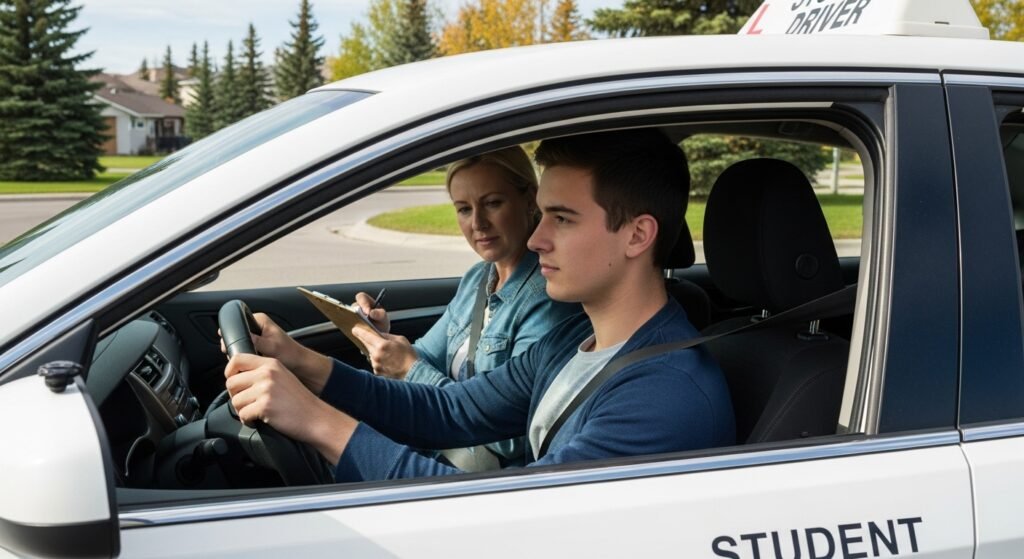
The Class 5 Basic Road Test measures whether you can drive safely without supervision. The test normally lasts around 25 to 30 minutes. The examiner looks for proper vehicle handling, awareness, and compliance with Alberta laws.
alberta driving test practice test questions free
What Examiners Look For
Examiners pay close attention to your observation patterns. This includes regular mirror checks, blind-spot shoulder checks, scanning intersections, and keeping track of nearby traffic. They also watch your lane positioning, speed management, and ability to follow traffic signals.
Proper steering control and smooth braking are important. Your driving should look confident and deliberate, not hesitant or erratic. Examiners want to see that you understand right-of-way rules, can make safe turns, handle residential areas, and interact with other road users responsibly.
Parking is also assessed. You may be required to perform maneuvers such as pulling over beside a curb, parking on a hill, or backing into a parking spot. The examiner looks for safety, accuracy, and awareness of surroundings.
alberta driving test practice test questions free
6. Alberta Class 5 Advanced Road Test Overview
This test lasts longer—about 55 to 60 minutes—and covers a wider range of driving environments. It is designed to confirm that an experienced driver can safely judge complex situations with confidence.
Skills Assessed in the Advanced Test
More complex maneuvers are included, such as merging onto highways, exiting at proper speeds, navigating multi-lane roundabouts, and dealing with heavy traffic. Hazard perception is key. You should anticipate risks before they occur, such as pedestrians approaching crosswalks, vehicles preparing sudden lane changes, or upcoming road work zones.
You will also need to demonstrate precise vehicle control, including smooth lane changes in busy conditions, awareness of vehicles approaching from multiple directions, and the ability to maintain safe following distances at higher speeds.
Parking expectations are higher as well. You must show that you can complete different parking types safely and fluidly, without unnecessary adjustments or unsafe movements.
alberta driving test practice test questions free
7. How Alberta Road Tests Are Scored
Examiners evaluate your driving using three categories of errors: minor errors, major errors, and critical errors that lead to immediate failure.
Minor Errors
These are small mistakes such as uneven lane positioning or forgetting occasional mirror checks. Too many minor errors combined can still fail the test because they indicate unsafe habits.
Major Errors
These involve more serious issues such as failing to fully stop at stop signs, misjudging gaps when turning, or inconsistent speed control. Major errors signal significant risk and often lead to failure.
Immediate Fail Errors
These include dangerous actions like driving through a red light, ignoring a yield requirement, nearly causing a collision, or forcing the examiner to intervene. Any of these ends the test immediately.
Understanding how errors are categorized helps you focus on strengthening specific areas before your test.
alberta driving test practice test questions free
8. Essential Driving Skills for Alberta Tests
Below are the most important categories of driving skills you need to develop for both the Basic and Advanced tests.
Observation and Awareness
Observation is the foundation of safe driving. You must consistently check mirrors, blind spots, intersections, and pedestrian areas. Examiners watch how often and how effectively you scan your environment. You should be looking far ahead, anticipating road conditions and potential hazards long before reaching them.
Lane Positioning
Good lane control means keeping your vehicle centered, avoiding drift, and maintaining smooth, predictable movement. In curves, the examiner expects steady control. In multi-lane situations, you must stay in the correct lane and avoid unintended lane changes.
Speed Control
Your speed must match the posted limit and adapt to conditions. Driving too slowly is considered unsafe and may result in failure. You should reduce speed when necessary for hazards, turns, or conditions like rain or snow.
Intersections
You must demonstrate strong knowledge of intersection rules. This includes making full stops, checking for pedestrians, looking for cross traffic, yielding when required, and executing left turns safely. Many drivers fail because they misjudge left-turn gaps or rush turns.
Lane Changes
Lane changes must be smooth, timely, and well-observed. Before every lane change, you must check mirrors, signal early, perform a shoulder check, maintain steady speed, and move smoothly into the new lane. Hesitation or uncertainty during lane changes is a common reason for failure.
Parking Skills
You must show that you can park safely and with control. Curb-side stops, hill parking, and reversing into parking spaces are commonly required. Awareness of surroundings is crucial: you must check blind spots, ensure space is clear, and apply the parking brake when needed.
Highway and Multi-Lane Driving (Advanced Test)
The advanced test expects solid performance on high-speed roads. This includes proper merging at highway speeds, maintaining steady lane positioning, and adjusting speed in traffic flow. Good judgment and confidence are essential here.
alberta driving test practice test questions free
9. How to Prepare for the Alberta Driving Tests
Study the Alberta Driver’s Guide Thoroughly
It contains all rules and explanations tested in both the knowledge and road tests. Reading it multiple times ensures familiarity with Alberta-specific laws.
Use Practice Resources
Many learners prepare using online tools offering Alberta driving test practice test questions free, which help reinforce the rules and concepts, even though this guide does not include sample questions.
Take Professional Driving Lessons
Certified instructors can identify weaknesses, teach test-specific techniques, and help you learn proper habits that examiners expect.
Practice in a Wide Range of Conditions
Driving at different times of day, during varied weather, and in different areas builds confidence. Practicing in areas similar to your test location is especially helpful.
Become Comfortable With Your Vehicle
Your test vehicle must be safe and roadworthy. Knowing how it responds during braking, turning, and accelerating will make your test smoother.
10. What to Expect on Test Day
Arrive early with your licence and ensure your vehicle is safe, insured, and mechanically sound. The examiner will explain the procedure before the test. Drivers are not tricked; instructions are clear and direct.
During the test, remain calm, focused, and consistent. Small mistakes happen, but safe driving and strong observation habits will keep you on track.
After the test, the examiner will review your performance and tell you whether you passed. If not, you are given feedback so you know what to improve before retaking the test.
alberta driving test practice test questions free
11. Final Thoughts
Passing the Alberta driving test requires a mix of knowledge, practice, confidence, and safe habits. Whether you’re preparing for the Class 7 Knowledge Test, the Class 5 Basic Road Test, or the Class 5 Advanced Road Test, understanding Alberta’s rules and expectations is the key to success. Using study guides, professional lessons, and online resources such as Alberta driving test practice test questions free can help you build the skills needed to become a safe, capable driver.