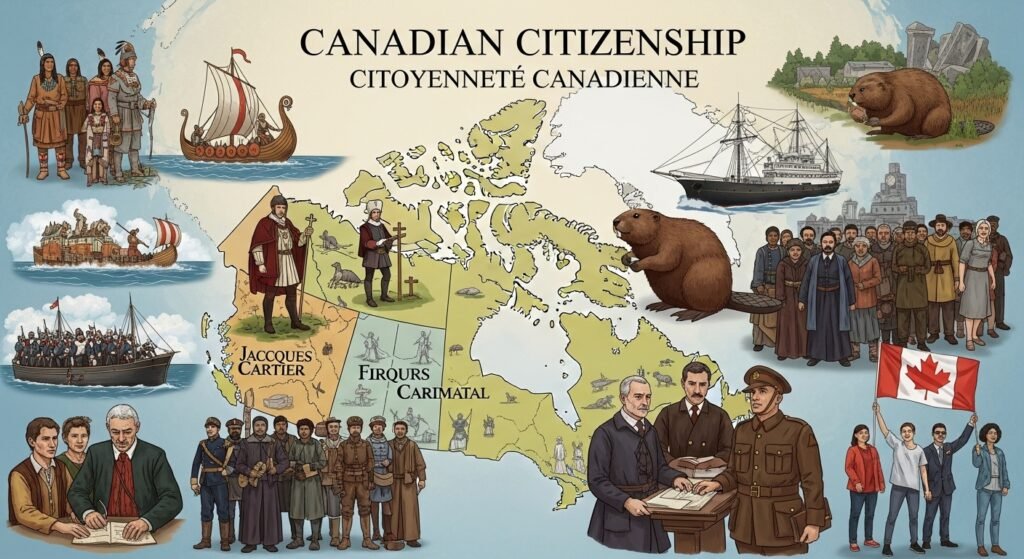
Canadian history for citizenship
Wrong shortcode initialized
Canada’s History – Overview for Citizenship Study
Canada’s history spans thousands of years and reflects Indigenous presence, European exploration and settlement, the formation of a constitutional democracy, and the ongoing development of a multicultural nation. Understanding Canada’s past helps explain its institutions, values, and identity today.
Canadian history for citizenship
Indigenous Peoples and Early Civilizations
Long before Europeans arrived, the land that is now Canada was home to diverse Indigenous Peoples, including First Nations, Inuit, and Métis. Indigenous cultures developed sophisticated political systems, trade networks, spiritual traditions, and knowledge of the natural environment.
First Nations lived in regions such as the plains, forests, and coasts.
Inuit inhabited the Arctic and adapted to harsh northern climates.
Métis emerged later through the blending of Indigenous and European cultures.
Indigenous societies played a central role in shaping Canada and continue to influence its political and cultural life.
Canadian history for citizenship
European Exploration and Settlement
European exploration began in the late 1400s and 1500s:
John Cabot explored the Atlantic coastline for England.
Jacques Cartier claimed territory for France along the St. Lawrence River.
Samuel de Champlain established New France and founded Quebec City in 1608.
French settlements grew around the St. Lawrence Valley, while British colonies developed along the Atlantic coast.
Canadian history for citizenship
The Struggle Between France and Britain
From the 1600s to mid-1700s, France and Britain competed for control of North America. Key events included:
Seven Years’ War (1756–1763)
The Battle of the Plains of Abraham (1759) near Quebec City
Britain captured New France and expanded its influence.
Canadian history for citizenship
The Road to Confederation (1867)
After British rule was established, the colonies evolved. Economic expansion, political debates, and the need for united defense led to Confederation.
Canadian history for citizenship
On July 1, 1867, four provinces united to form the Dominion of Canada:
Ontario
Quebec
Nova Scotia
New Brunswick
Confederation created a federal system with powers shared between provincial and national governments.
Canadian history for citizenship
Expansion West and the Métis
Canada gradually expanded westward, forming new provinces and territories. Conflicts arose over land and political rights, especially involving the Métis under leaders such as Louis Riel. The Métis played a crucial role in shaping Western Canada.
Canadian history for citizenship
Industrialization and Immigration
In the late 1800s and early 1900s, Canada industrialized rapidly. Waves of immigrants contributed to population growth, agriculture, mining, railways, and urban development. The Canadian Pacific Railway connected east and west, strengthening national unity.
Canadian history for citizenship
World Wars and Global Role
Canada emerged as an independent international contributor during the 20th century:
Canadian history for citizenship
World War I (1914–1918): Canadian forces fought in major battles, including Vimy Ridge.
World War II (1939–1945): Canada helped liberate Europe and supported global peace efforts.
Participation in the wars strengthened national identity and led to greater autonomy from Britain.
Canadian history for citizenship
Post-War Society and Modern Change
After WWII, Canada expanded social programs, welcomed immigration, and diversified economically. Important developments included:
Multiculturalism policy (1971)
Canadian Charter of Rights and Freedoms (1982)
Creation of a modern welfare state
Strengthening of Indigenous rights movements
Canadian history for citizenship
Indigenous Rights and Reconciliation
Late 20th and early 21st century history highlights renewed focus on Indigenous rights, land claims, and reconciliation. The legacy of residential schools, treaties, and cultural preservation forms a key part of contemporary historical understanding.
Canadian history for citizenship
A Modern Multicultural Democracy
Today, Canada is recognized for:
Parliamentary democracy
Constitutional monarchy
Bilingualism (English and French)
Multicultural and immigrant-inclusive identity
Commitment to peace, human rights, and equality
Canada’s historical evolution continues to shape its democratic values and civic expectations.
Canadian history for citizenship