Canada historical events citizenship test
Canada’s History – Citizenship Test Guide
Canada’s history is long and diverse, shaped by Indigenous peoples, European settlers, and the development of a modern nation. Learning Canada’s history helps newcomers understand the country’s values of democracy, equality, and diversity, and is an important part of the citizenship test.
Canada historical events citizenship test
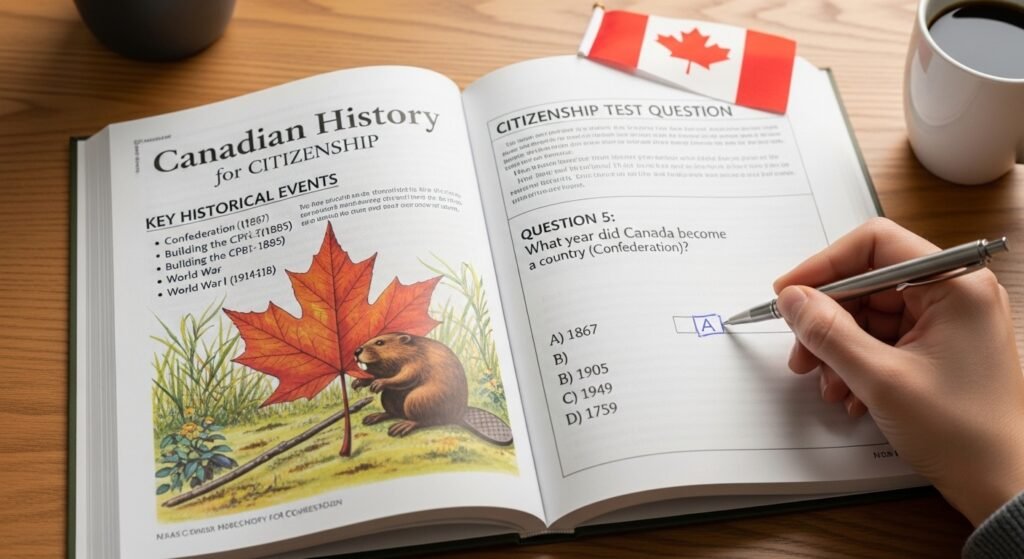
Canada’s history is long and diverse, beginning with the Indigenous peoples, including the First Nations, Inuit, and Métis, who lived across the land with unique cultures, languages, and traditions. European exploration began in the late 1400s, with John Cabot claiming land for England and Jacques Cartier for France. The French established New France, which included Quebec and Montreal, while the British expanded colonies along the Atlantic coast. In 1867, Canada became a self-governing Dominion through Confederation, starting with Ontario, Quebec, New Brunswick, and Nova Scotia. Over time, more provinces and territories joined, creating the modern country. Canada participated in World War I and II, gaining recognition on the world stage, and gradually achieved full sovereignty with the Statute of Westminster (1931) and the Constitution Act (1982). Today, Canada is a constitutional monarchy and parliamentary democracy, embracing multiculturalism, equality, and human rights, and its history reflects the contributions of Indigenous peoples, settlers, and immigrants.
Canada historical events citizenship test
1. Indigenous Peoples
Indigenous peoples, including First Nations, Inuit, and Métis, were the first inhabitants of Canada.
They developed unique cultures, languages, and traditions, living off hunting, fishing, and farming.
Today, Indigenous communities continue to be a vital part of Canadian society.
Canada historical events citizenship test
2. European Exploration
1497: John Cabot explored eastern Canada for England.
1534: Jacques Cartier claimed land along the St. Lawrence River for France.
Early European settlements focused on fishing, trading, and fur trading with Indigenous peoples.
Canada historical events citizenship test
3. New France and British Colonies
New France included Quebec, Montreal, and nearby areas.
French settlers built alliances with Indigenous peoples and developed farms and trade networks.
1763: Treaty of Paris ended the Seven Years’ War; France gave most of its Canadian territory to Britain.
British colonies grew along the Atlantic coast.
Canada historical events citizenship test
4. Confederation (1867)
Canada became a self-governing Dominion through the British North America Act (Constitution Act 1867).
Original provinces: Ontario, Quebec, New Brunswick, Nova Scotia.
Confederation united colonies, strengthened the economy, and created a federal government.
Canada historical events citizenship test
5. Expansion of Canada
Over time, more provinces joined:
Manitoba (1870)
British Columbia (1871)
Prince Edward Island (1873)
Alberta and Saskatchewan (1905)
Newfoundland and Labrador (1949)
Territories were created: Yukon, Northwest Territories, Nunavut.
Canada historical events citizenship test
6. Canada on the World Stage
World War I (1914–1918): Canada fought alongside Britain and gained international recognition.
World War II (1939–1945): Canada contributed troops, resources, and leadership in global affairs.
Canada gained full sovereignty with the Statute of Westminster (1931) and the Constitution Act (1982).
Canada historical events citizenship test
7. Canadian Society and Culture
Canada has two official languages: English and French.
Multiculturalism is a core value, welcoming people from all backgrounds.
Indigenous, immigrant, and settler cultures all contribute to Canada’s diverse society.
Canada historical events citizenship test
8. Key Documents
Constitution Act (1867): Established Canada’s federal government and division of powers.
Canadian Charter of Rights and Freedoms (1982): Protects fundamental rights and freedoms.
Treaties with Indigenous peoples: Recognize Indigenous rights and land agreements.
Canada historical events citizenship test
9. Modern Canada
Canada is a constitutional monarchy and parliamentary democracy.
Citizens enjoy rights and freedoms protected by the Charter.
Canada continues to uphold democracy, equality, and multiculturalism.
Canada historical events citizenship test