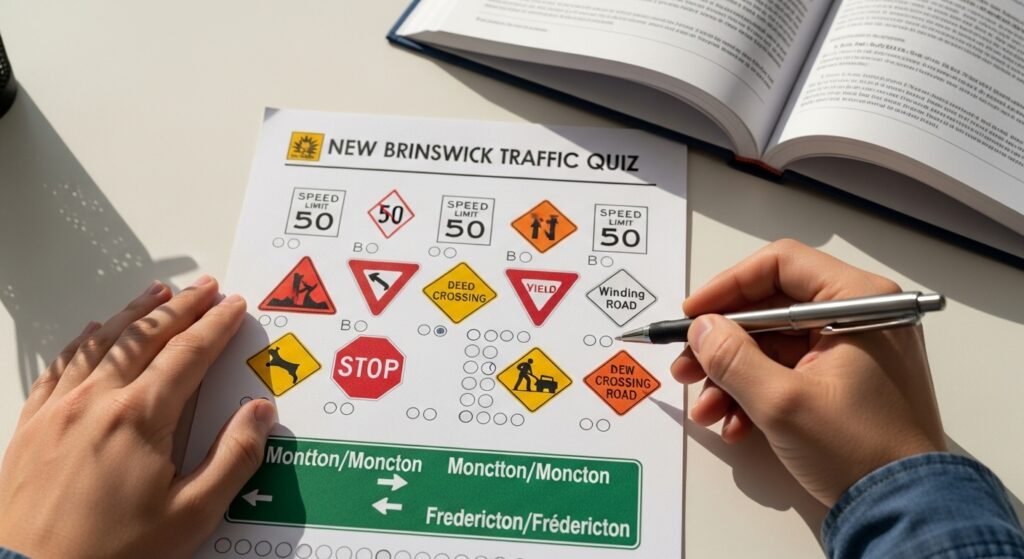
New Brunswick Class 7 sign test

Time's up
New Brunswick Driving Signs – Description
New Brunswick driving signs are used to communicate important information to drivers, ensuring safety and smooth traffic flow on NB roads. These signs fall into several categories, each with a specific purpose:
New Brunswick Class 7 sign test
1. Regulatory Signs
These signs inform drivers of rules and laws that must be obeyed. Common examples include:
Stop
Yield
Speed Limit
No Passing
Lane Control
Failing to follow regulatory signs can result in fines or traffic violations under the New Brunswick Motor Vehicle Act.
New Brunswick Class 7 sign test
2. Warning Signs
Warning signs alert drivers to upcoming hazards or changes in the road environment. They are often yellow and diamond-shaped. Examples include:
Sharp Curve Ahead
School Zone
Pedestrian Crossing
Animal Crossing
Railway Crossing
These signs give drivers time to slow down and react safely.
New Brunswick Class 7 sign test
3. Guide & Informational Signs
Guide signs help drivers navigate the road network by providing directions, distances, and route numbers. Informational signs may indicate rest areas, hospitals, or service locations. Examples include:
Highway Route Markers
Exit Signs
Destination Distance Signs
Service Information
New Brunswick Class 7 sign test
4. Construction & Temporary Signs
These orange signs warn of roadwork, lane changes, and temporary hazards. Examples include:
Road Work Ahead
Flag Person Ahead
Reduced Speed in Construction Zone
New Brunswick Class 7 sign test
5. Traffic Signals & Pavement Markings
New Brunswick also uses standard traffic lights, arrows, and painted road markings to control traffic flow, right-of-way, and lane use.
New Brunswick Class 7 sign test
Importance for Class 7 Knowledge Test
Learning NB driving signs is essential for passing the Class 7 Learner’s Knowledge Exam. The test requires you to:
recognize signs by shape, color, and symbol
know what each sign instructs or warns
apply sign rules while driving