Preparing for the Ontario driving test is one of the most important steps toward becoming a licensed driver in the province. Whether you are a new learner, a young student, or an experienced driver immigrating from another country, understanding the testing process and practicing effectively can make a significant difference in confidence and exam results. Ontario uses a graduated licensing system that progresses from G1 (written exam) to G2 (first road test) and finally the G (highway-focused road test). Each stage assesses specific knowledge and driving skills, and practicing ahead of time gives learners an advantage in both safety and performance.
Ontario driving test practice questions
1. Understanding the Ontario Licensing System
Ontario’s licensing process is designed to reduce collision rates and encourage gradual skill development. The system features three stages: G1 → G2 → G.
G1 focuses on theoretical knowledge, sign recognition, and traffic rules.
G2 measures independent city driving, observation, vehicle control, and hazard response.
G tests full driving maturity, including highway merging, lane changes, and advanced defensive driving.
Graduated licensing limits distractions, introduces rules step-by-step, and provides practice time between levels. Learners are required to wait a minimum period between each stage, although accredited driving schools may shorten the G1 to G2 waiting period. This structure allows new drivers to gain real driving experience before receiving full road privileges.
Ontario driving test practice questions
2. G1 Written Knowledge Test — Practice & Preparation
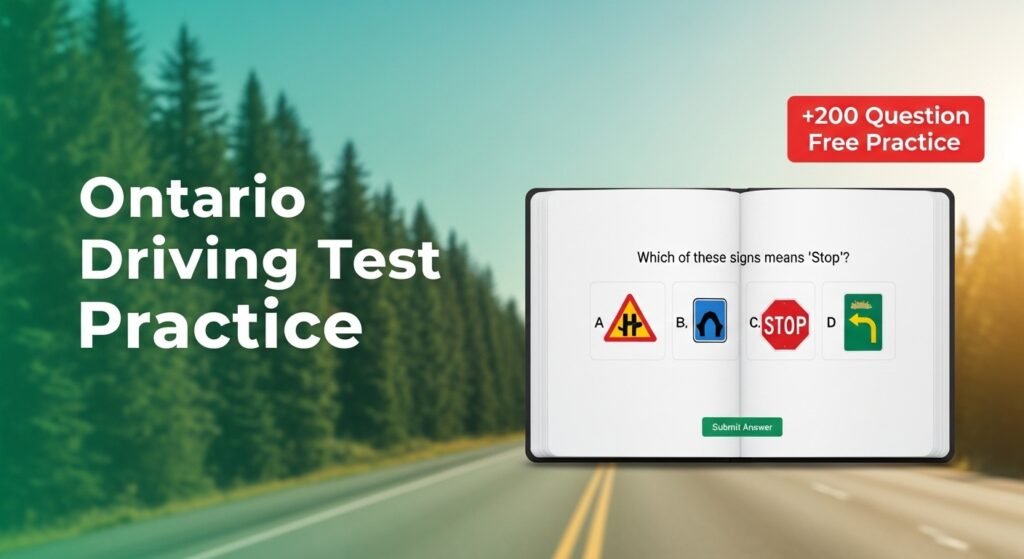
The G1 test is often the first challenge new drivers face. It is a written, multiple-choice exam conducted at DriveTest centres. The test contains questions on:
Traffic rules
Signs and signals
Road laws
Speed regulations
Vehicle safety
Right-of-way rules
Distracted and impaired driving penalties
To prepare, students typically study the Official MTO Driver’s Handbook, review online sign charts, and complete practice quizzes that simulate the exam format. The G1 test is not considered difficult, but many students fail on their first attempt due to overconfidence or unfamiliarity with signs. Practicing improves memory, reduces test anxiety, and helps learners understand how Ontario applies rules such as yielding, lane discipline, and pedestrian safety.
Ontario driving test practice questions
3. G1 Restrictions and Practice Period
After passing the G1 exam, new drivers enter a learning stage that includes several restrictions intended to promote safety and limit risk. G1 drivers must always be accompanied by a fully licensed driver with at least four years of experience and must not drive on 400-series highways unless supervised by a certified driving instructor. G1 drivers also have a zero-alcohol requirement, must avoid driving between midnight and 5 a.m., and cannot exceed passenger seatbelt capacity.
This restricted stage provides time for learners to practice real-world driving skills such as scanning, braking, signaling, and lane position. Safe practice builds confidence and prepares drivers for the upcoming G2 road test. Many choose to take certified driving courses to accelerate progression or improve skill development.
Ontario driving test practice questions
4. G2 Road Test — What Examiners Look For
The G2 road test is the second major step, allowing learners to drive independently without supervision. Examiners evaluate whether drivers can safely operate a vehicle in city environments. Critical skills include:
Smooth and consistent speed control
Proper signaling before lane changes and turns
Awareness of pedestrians, cyclists, and other vehicles
Judgment at intersections
Correct use of mirrors and blind spot checks
Ability to park, reverse, and navigate residential streets
Safe gap selection when merging or turning
The G2 test typically includes several core components: residential driving, parking maneuvers, three-point turns, and sometimes light urban traffic. The examiner’s main priority is to determine whether the driver is predictable and cautious rather than aggressive or hesitant. Practice makes these behaviors automatic.
Ontario driving test practice questions
5. G Road Test — Advanced Practice and Highway Performance
Once the G2 stage is completed and sufficient experience has been gained (usually 12 months for standard learners), drivers move to the final G test. The G test focuses on highway performance and advanced driving. Skills evaluated include:
High-speed merging onto 400-series highways
Maintaining appropriate speed and spacing
Smooth lane changes with clear blind-spot checks
Exiting and re-entering highways safely
Advanced defensive driving strategies
Predictable maneuvering and hazard anticipation
Highway practice can be intimidating for new drivers due to higher speeds and dense traffic, but structured practice builds competence. Driving instructors often create targeted training plans to introduce highway scenarios gradually, which reduces test anxiety and increases pass rates.
Ontario driving test practice questions
6. Road Sign Practice — A Key Component for Success
Signs play a crucial role in Ontario driving tests. Ontario roads feature regulatory signs (speed limits, lane control, no passing), warning signs (curves, schools, wildlife), and information signs (directions, services, highway routes). Sign recognition ensures drivers respond to hazards early and follow rules consistently.
Common sign categories learners should practice include:
Speed limit signs
Stop and yield signs
School zone and pedestrian signs
Construction and temporary signs
Directional and service signs
Lane control signs
No-turn and no-entry signs
Consistent sign practice helps reduce the cognitive load during real driving. Many G2 and G test failures happen because drivers overlook signs or fail to adjust speed and position accordingly.
Ontario driving test practice questions
7. Defensive Driving — The Foundation of Ontario Testing
Defensive driving is a major theme across all licensing stages. Examiners evaluate whether drivers can predict hazards and respond early rather than react late. Defensive driving includes:
Maintaining safe following distances
Reducing risks at intersections
Controlling speed appropriately
Checking mirrors frequently
Scanning for pedestrians and cyclists
Avoiding distractions and sudden maneuvers
Ontario emphasizes collision prevention and courteous driving, which aligns with Canadian road culture. Practicing defensive behaviors helps ensure success not only in testing but in everyday driving.
Ontario driving test practice questions
8. For Newcomers and Foreign Licence Holders
Ontario welcomes thousands of newcomers every year, many of whom have previous driving experience. Some foreign licences can be exchanged directly for an Ontario licence without retesting if the country has an agreement. Others may require knowledge or road tests. For these drivers, practice is still beneficial because road rules, sign standards, and intersection etiquette may differ from their home country. Practicing prevents automatic habits that conflict with Ontario rules and increases pass rates significantly.
Ontario driving test practice questions
9. Benefits of Driving Test Practice
Consistent practice delivers numerous advantages:
Reduces test anxiety
Improves memory recall
Enhances observation and decision-making
Develops automatic safe habits
Helps prevent common mistakes
Increases passing probability
Supports safer real-world driving
Driving schools often report that the best-performing students are those who practiced regularly in both structured and unstructured environments.
Ontario driving test practice questions
10. Most Common Mistakes Learners Make
Frequent errors that lead to failure include:
Rolling stops at stop signs
Forgetting blind spot checks
Speeding or driving too slowly
Poor lane discipline
Hesitation at intersections
Cutting turns too sharply
Failing to yield pedestrians
Improper merging or exiting
Inconsistent mirror scanning
Practice reduces these mistakes by turning rules into instinctive behaviors.
Ontario driving test practice questions
Conclusion
Practicing for the Ontario driving test is not merely about passing exams; it is about developing safe, consistent, and responsible driving habits. The combination of written knowledge, road sign understanding, and hands-on driving skills reflects the reality of Ontario’s roads. By studying, practicing, and building confidence over time, learners dramatically improve their chances of success at each licensing stage from G1 to G2 to G. Whether self-taught, guided by friends and family, or enrolled in official driving courses, the key to success is preparation, awareness, and consistent practice.