Truck Licence Sign Practice Test Quiz

“The Official MTO Air Brake Handbook.”

🚛 Part 1: Regulatory Signs (Mandatory Rules for Trucks)
Regulatory signs are the most critical category for truck drivers in Ontario. These signs represent enforceable laws that must be followed at all times. Failure to obey them can lead to penalties such as fines, demerit points, or suspension of your commercial licence. These signs are typically displayed with a white background and black text or symbols, and many include a red circle with a diagonal slash to indicate prohibition.
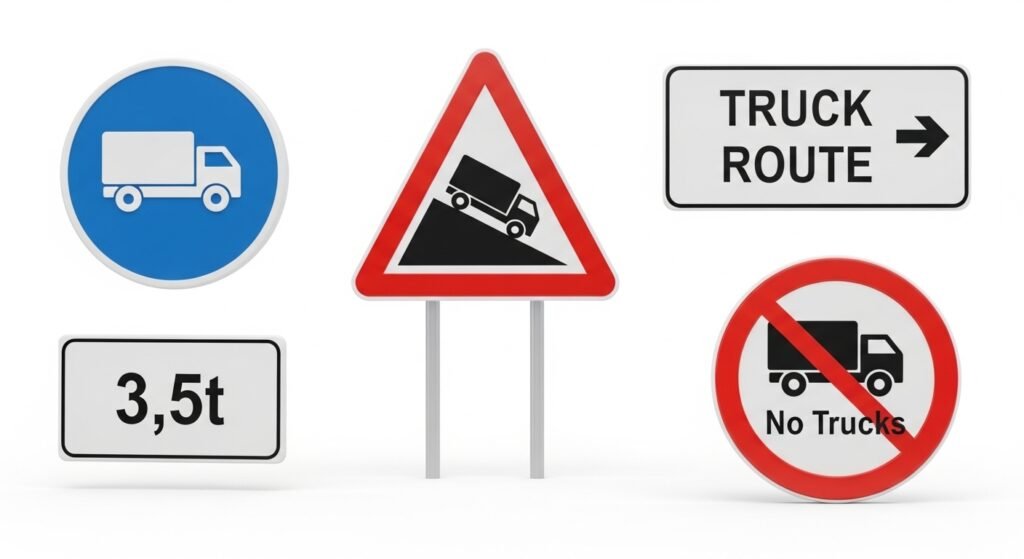
One common sign is the “No Trucks” sign, which clearly indicates that all truck traffic is forbidden on a particular road. This is often used in residential neighborhoods or areas where large vehicles could create safety hazards or damage infrastructure. Another variation is the “No Heavy Trucks” sign, which restricts access only to large commercial vehicles while allowing smaller trucks to pass.
Truck Licence Sign Practice Test Quiz
Truck route signs are equally important, as they guide drivers toward roads specifically designed to handle heavy vehicles. These routes are safer and better suited for large trucks due to wider lanes and stronger road surfaces. In contrast, “Local Deliveries Only” signs permit trucks to enter a road only if they are making a nearby delivery, preventing unnecessary through traffic.
Truck Licence Sign Practice Test Quiz
Lane restriction signs also fall into this category. For example, trucks may be prohibited from using the left lane on highways, ensuring smoother traffic flow and reducing the risk of collisions.
Truck Licence Sign Practice Test Quiz
⚖️ Part 2: Weight, Height, and Size Limit Signs
Weight and dimension signs are essential for protecting roads, bridges, and tunnels. These signs inform drivers about the maximum allowable limits for their vehicles. Ignoring these restrictions can result in serious consequences, including fines, infrastructure damage, or dangerous situations such as getting stuck under a low bridge.
Maximum weight signs indicate the total allowable weight of a truck, including its cargo. Drivers must ensure their vehicle does not exceed this limit. Axle weight signs are more specific, restricting the weight carried by each axle, which is crucial for proper load distribution.
Truck Licence Sign Practice Test Quiz
Height clearance signs warn drivers of low bridges or overhead structures. If a truck exceeds the indicated height, it must not proceed. Width and length restriction signs also help regulate oversized vehicles, especially in narrow or confined areas.
Understanding and respecting these limits is vital for both safety and compliance. Drivers are expected to plan their routes in advance to avoid restricted areas.
Truck Licence Sign Practice Test Quiz
🛑 Part 3: Inspection and Enforcement Signs
Inspection and enforcement signs are designed to ensure that commercial vehicles meet safety and regulatory standards. These signs are closely associated with inspections carried out by authorities such as the Ministry of Transportation of Ontario.
A common example is the “Truck Inspection Station Ahead” sign, which alerts drivers to prepare for a possible stop. Drivers should ensure that their vehicle is in proper working condition and that all required documents are available.
Another important sign states, “Trucks Must Enter When Flashing.” This means that when lights are activated, all trucks are required by law to enter the inspection station. Failure to comply can result in significant penalties.
Weigh station signs are also part of this category. These stations check whether trucks are operating within legal weight limits. Overloaded vehicles can pose serious risks to road safety and infrastructure.
Truck Licence Sign Practice Test Quiz
☣️ Part 4: Dangerous Goods Signs
Dangerous goods signs apply to vehicles transporting hazardous materials such as chemicals, fuel, or explosives. These signs are essential for public safety and emergency response.
Certain routes may restrict or prohibit the transportation of hazardous materials. Drivers must follow these restrictions carefully to avoid high-risk areas such as tunnels or densely populated zones.
In addition to road signs, trucks carrying dangerous goods must display placards that identify the type of material being transported. These placards help emergency responders quickly assess the situation in case of an accident.
Handling dangerous goods requires additional responsibility, including proper labeling, route planning, and compliance with safety regulations.
Truck Licence Sign Practice Test Quiz
⚠️ Part 5: Warning Signs for Truck Drivers
Warning signs are designed to alert drivers to potential hazards ahead. These signs are usually yellow with black symbols and are not legally enforceable, but they play a crucial role in safe driving.
For truck drivers, warning signs are especially important due to the size and weight of their vehicles. A “Steep Hill” sign indicates that drivers should shift to a lower gear to maintain control and prevent brake overheating. A “Sharp Curve” sign warns of a bend in the road that requires reduced speed to avoid rollover.
Other warning signs may indicate truck entrances, slippery roads, or uneven surfaces. These conditions can significantly affect a truck’s handling and stopping distance.
Drivers are expected to adjust their driving behavior based on these warnings to maintain safety.
Truck Licence Sign Practice Test Quiz
🚧 Part 6: Special Truck Signs and Unique Situations
Special truck signs cover a range of unique situations that do not fall under standard categories. These signs help drivers and other road users understand unusual vehicle conditions or road environments.
An “Oversize Load” sign is used for trucks carrying exceptionally large cargo. These vehicles often require escort vehicles and additional precautions. The “Slow Moving Vehicle” sign, represented by an orange triangle, indicates vehicles traveling at speeds below 40 km/h.
Long Combination Vehicle (LCV) signs refer to trucks with multiple trailers. These vehicles require more space for turning and longer distances to stop.
Construction zone signs are also important, as they indicate temporary changes in road conditions. Truck drivers must reduce speed and follow all posted instructions in these areas, as penalties are typically higher.
Truck Licence Sign Practice Test Quiz
🧠 Final Summary
Truck licence signs in Ontario are designed to ensure safety, efficiency, and compliance on the road. Each category of signs serves a specific purpose, from enforcing laws to providing warnings and guiding drivers through special conditions.
Understanding these signs is essential for passing the Class A licence test and for operating a commercial vehicle safely. By learning how to recognize and respond to each type of sign, drivers can reduce risks and contribute to a safer transportation system.
Truck Licence Sign Practice Test Quiz